Our Story
Our family has adventured and celebrated along Lake Superior and the North Shore for generations, from a 1964 honeymoon in the BWCA to lifetimes of boating and backpacking adventures in the Apostle Islands. We even got married on Lake Superior’s shore surrounded by lupine and wildflowers.
We created Sisu Creek Retreat in honor of all of these treasured memories, infusing the farmhouse’s style with family heirlooms from our 1970s childhoods and our Scandinavian ancestors. We are honored to be the newest caretakers of this historic farmhouse and property previously called home by four generations of Finnish families.
Connect, recharge, and explore at Sisu Creek Retreat! We hope some of this North Shore magic rubs off on you and your loved ones.
The History of the Property
As the last Ice Age ended about 10,000 years ago, Minnesota’s climate warmed, its forests changed, and people lived on the edges of forests and prairies. To learn more about the geology of Finland, MN, read here and join a geology walk at Sugarloaf Cove. Over time indigenous peoples of what’s now called Minnesota lived and traded along the Great Lakes. As European empires competed, explored, and conquered, an economy of trapping and fur trading developed with French Voyageurs arriving and trading with indigenous communities by the mid-1600s. Both the French and British sought alliances with the Anishinaabe and Dakota people. The Minnesota Historical Society has brief summaries of these eras available on their website. As trapping and fur trading declined, from 1805-1867 the US government negotiated treaties with indigenous communities in what is now called Minnesota. Minneapolis and Saint Paul are located on land the U.S. acquired from the Dakota in 1805. In the Treaty of LaPointe signed in 1854 and several earlier treaties, the Ojibwe ceded land in what’s now Wisconsin, Michigan and northeastern Minnesota. Once these treaties were signed and the governments of the United States and later Minnesota pushed Native Americans onto reservations, the logging and mining industries harvested the natural resources of Minnesota, stripping and transforming the landscape. Learn more about indigenous history and the North Shore through the Ojibwe names along the North Shore here.
Finnish and a smaller number of Swedish immigrants landed at Kennedy Landing and, carrying everything they owned, hiked up into the Sawtooth Mountains to find land near what’s now called Finland, Minnesota, arriving mostly in the early 1900s. The land in the Sawtooth Mountains along the Baptism River is rugged and isolated and reminded these Nordic immigrants of their homelands in northern Europe. Many Finns left Finland to escape poverty, famine, and conscription into the Russian military. The establishment of this community involved sisu — sustained hard work, resilience, and caring for one another and building community through dances and music, the establishment of country schools and community organizations, mutual aid, and community celebrations.
All supplies came by ship from Duluth to Kennedy Landing, and then immigrants carried food and other goods on their backs 4+ miles into the Sawtooth Mountains along Lake Superior. Families often built a sauna first and lived in it for a year while they sawed trees, cleared land, and built a one-room cabin. Mail came by sailboat or steamship in the summer and by dogsled in winter, including deliveries by the famous dogsledder John Beargrease from 1879-1899.
In 1907 the Alger Smith Company built a railroad to the area, which enabled goods to reach the area and logging companies to extract white pines, cedars, balsam firs, and white spruce. This logging led to major fires in the region in 1908-1910 and in the mid 1920s. The Finland, MN community organized the first cooperative in Minnesota in 1913. Be sure to visit the Finland Cooperative when you’re passing through town! Electricity reached the region in 1939, when there were about 179 Finnish families in the area farming grains, vegetables, berries, apples, cows and pigs, though cream was the only product generally sold from the farms. People traveled in the area by foot, skis, horse, dogsled, wagon, sleigh, boat, train, and eventually car/truck. Highway 61 along Lake Superior was constructed and paved by 1940. Town meetings in Finland were still held in the Finnish language in the 1940s! Learn more about this era by visiting the Finland Minnesota Historical Society (May-October) across and just down the street from Sisu Creek Retreat.
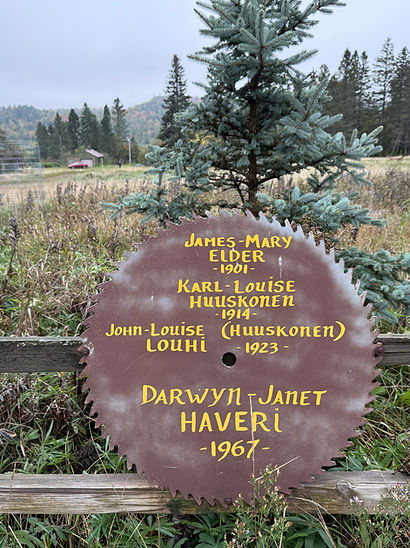
The land that is now Sisu Creek Retreat was home to multiple generations of Finnish families. In 1901 the land was purchased by James Elder. At this time, we think there was a logging camp on the property as was common during this era of heavy logging. In 1914 Louise and Karl Huuskonen purchased the land and made it a dairy farm. In the lower level of the Sisu Creek Retreat house (behind the small door across from the washer/dryer), you can see where an artesian well provided constantly cold water where the farmers kept their milk cold. Karl passed away, and Louise married John Louhi in 1919 and built the farmhouse that is now Sisu Creek Retreat in 1920. They continued their dairy farm and leadership in the community until they sold the property in 1967 to Janet and Darwyn Haveri, whose families were both Finnish immigrants in the area. They continued to farm, raised two children in the farmhouse, and were vibrant community members playing music, farming, volunteering at Wolf Ridge Environmental Learning Center, and gardening. Janet worked as a nurse and Darwyn farmed and ran a small business and loved aviation. He learned how to fly, built his own ultralight plane, and used the front meadow of the property as a runway. He built the plane hangar in 2001, which is now a fun space to play pickleball, foosball, and has served as a place where the community has dried wild rice during the fall harvest.
Melanie and Erik, who both have Finnish and Scandinavian ancestors and are educators in Saint Paul, bought the property from the Haveris in 2025. Our families have long loved Lake Superior, the North Shore and the Boundary Waters, and our families were farmers two generations ago as well. Many of our families’ historic artifacts decorate the walls and spaces of Sisu Creek Retreat. We are working to diversify the ecosystem, reforesting with an array of native tree species and planting the front meadow with native pollinator species to create a beautiful and fruitful space for all creatures. We are delighted to share this property with other families and friends as a homebase for us all to connect, recharge and explore.
What is Sisu?
A rough translation from Finnish is rugged and quiet determination and perseverance – sustained courage in the face of adversity, and a commitment to collective well-being and care for the community. We call the creek that runs past the sauna at our farm Sisu Creek (thus Sisu Creek Retreat). Sisu, whether we call it that or not, is a common thread through all the communities who contribute to and shape our Minnesota community, regardless of ethnic heritage!
Downhill from the garage you’ll find another smaller creek running past a cedar tree and out of a clump of bunchberries. We call this creek Fika Creek. We’re both Swedish as well as Finnish, so we like to nod to our Swedish heritage along this creek. Fika in Swedish means taking an intentional break to rest and socialize over coffee/tea and a sweet treat.
Regardless of our heritage, if we nurture our sisu and our fika, we’re sure to live a tenacious, reflective, connected and balanced life in a community of joy, care and courage!
Learn a bit more about Finland, MN in this video and more about the concept of sisu here.
Read more about the incredible ecosystem, geology, and history around Finland, MN, in North Shore: A Natural History of Minnesota’s Superior Coast (book available to peruse at Sisu Creek Retreat). Beginning on page 59 there’s a fantastic chapter that helps us appreciate the bugs of the North Shore a bit more through the lens of bird migration. All those summer insects provide food for the richest bird biodiversity north of Mexico along Minnesota’s North Shore!
Recipes from Finland,
Minnesota’s founding families:
Mother’s Cardamom Bread
5 T. dry yeast
1 qt. milk, scalded and cooled
3 c. sugar
4 t. salt
½ # butter
8-10 eggs
10 cardamom seeds, ground
12-16 c. flour
2 t. vanilla
¾ c. warm water
Beat eggs well. Add sugar and beat. Add vanilla and salt. In a large bowl, mix cooled milk, egg mixture and yeast, which has been dissolved in warm water, about 8 cups of flour and cardamom. Beat well with an electric beater. Add more flour as needed and beat with a wooden spoon. Turn onto a floured board and knead, adding flour when it gets sticky, but keep dough as soft as possible. Place in an oiled bowl and place in warm place to rise. When doubled, punch down and let rise again. Form into braids or any kind of rolls and let rise again. Bake at 350 degrees for about 30 minutes. Brush with a glaze made of coffee and sugar (1 ½ c. coffee and ½ c. sugar). Recipe from Mary Nikolai as shared in How We Remember.
Kal Keitto (Finnish Fish Soup)
5-6 potatoes, diced
1 onion, chopped
7-8 pieces lake trout or walleye
A few whole allspice
1 qt. milk
2 T. butter
1 T. salt
2-3 carrots, sliced
1 stalk celery, sliced
Parsley, small bunch
Peel potatoes; cover with water and boil with salt, onions and carrots. When the potatoes are getting soft, add the fish and boil for 15 minutes. Drain out most of the water. Add milk, butter, allspice, and celery. Cook slowly until potatoes and fish are done. Garnish with parsley. From Diane Lindberg as shared in How We Remember.
Edit Palm’s Lemon Pie
1 c. sugar
2 T. cornstarch
2 T. flour
⅛ t. salt
1 ½ c. boiling water
2 egg yolks
Juice and grated rind of one lemon
1 t. butter
Place dry ingredients on top of double boiler. Add boiling water, stirring constantly. Cook until mixture begins to thicken. Add slightly beaten egg yolks, lemon juice and rind; cook 2 minutes. Remove from heat and add butter. Pour into baked shell. Use the egg whites for meringue and brown.
No-Fail Meringue
1 T. cornstarch
2 T. cold water
½ c. boiling water
3 egg whites
6 T. sugar
1 t. vanilla
Mix cornstarch and water in small pan; then add ½ c. boiling water. Cook until clear; cool completely. Beat egg whites until foamy. Gradually add sugar, beat until stiff, but not dry. Add vanilla and dash of salt. Add the cornstarch mixture; beat until stiff. This will cover 9-inch pie. Bake at 350 degrees for 10-15 minutes. Recipe from the infamous Palm’s Store in early Finland as shared in How We Remember.
Sources:
Anderson, C. and A. Fischer. North Shore: A Natural History of Minnesota’s Superior Coast. Minneapolis: University of Minnesota Press, 2015.
Finland Schools Reunion Committee. Keeping Our Heritage. Finland, Minnesota 1895-1976. 1976.
Forest History center timeline. MNHS. https://www.mnhs.org/foresthistory/learn/timeline.
Miller, Jim. Geologic History of the Finland Area, adapted from Tikkanen, B. and M. Duhant, From, S. How We Remember: Stories and Recollections of Finland, Minnesota’s First Century 1895-1995. Superior: Arrowhead Printing, 1995, 5.
Minnesota Treaty Interactive. MNHS. https://www.mnhs.org/usdakotawar/history/treaties/minnesota-treaty-interactive.
Redix, Erik. Rivers of Lake Superior’s North Shore: Historical Methodology and Ojibwe Dialects. Open Rivers: Rethinking Water, Place & Community, 2024. https://openrivers.lib.umn.edu/article/rivers-north-shore-ojibwe-dialects/
Tikkanen, B. and M. Duhant, From, S. How We Remember: Stories and Recollections of Finland, Minnesota’s First Century 1895-1995. Superior: Arrowhead Printing, 1995.